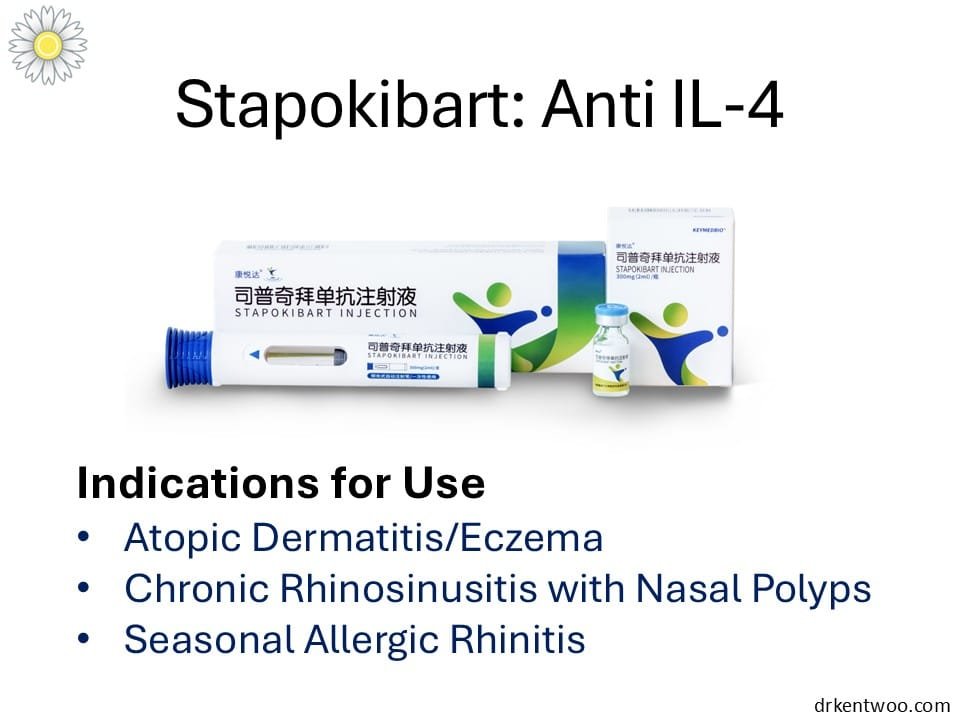
Stapokibart for Moderate-to-Severe Eczema
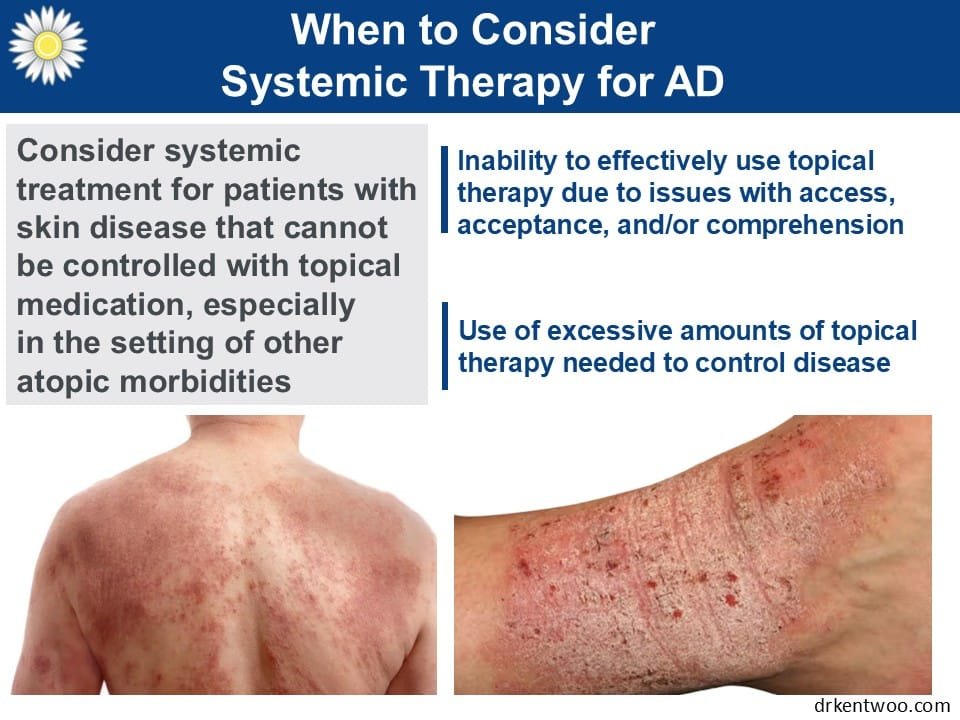
Sometimes eczema reaches a point where the usual treatments are simply not enough.
You have used moisturizers.
You have used steroid creams and other topical treatments.
Perhaps you’ve tried light therapy or oral medications.
And yet the itch keeps coming back.
The skin keeps flaring.
Sleep is affected.
Quality of life starts to suffer.
At this point, we start thinking beyond creams.
And this is where biologic treatments can make a big difference.
Meet the New Kid on the Block
There is now another biologic treatment worth knowing about:
Stapokibart.
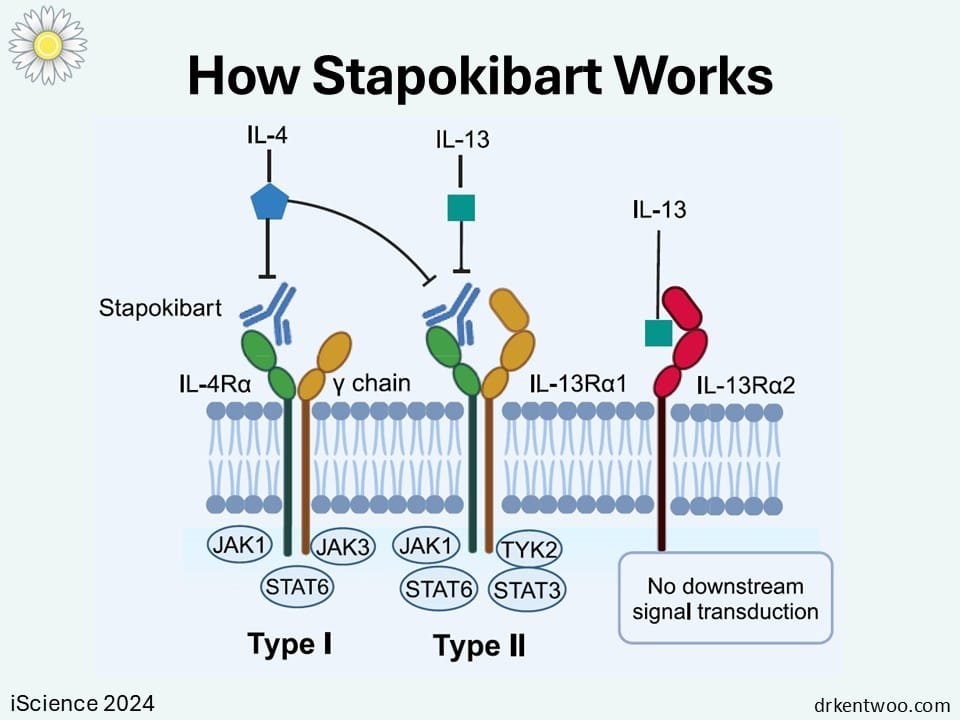
It is designed to target one of the key pathways driving eczema — the IL-4 and IL-13 pathway.
Stapokibart blocks the IL-4 receptor alpha (IL-4Rα), interfering with signals from both IL-4 and IL-13.
In simple terms:
Less inflammatory signaling → less inflammation → less itch → better-controlled eczema.
And the clinical results so far are encouraging.
In Phase 3 studies, stapokibart produced significant improvements in eczema severity and itch compared with placebo, with benefits maintained during longer-term treatment.
So naturally, the next question is:
Stapokibart vs Dupixent

Let’s talk about the OG.
Dupixent was the original biologic targeting this pathway for eczema.
It has been around longer, has extensive clinical experience behind it,
And remains an important treatment option for moderate-to-severe eczema.
Stapokibart is different.
It is a different antibody, but it targets the same IL-4Rα pathway.
So I wouldn’t describe Stapokibart as:
“the new Dupixent.”
Nor would I say it is automatically better.
I would describe it more simply:
It is another tool in our toolbox.
And having another good option matters.
“Doctor, Dupixent Works… But So Expensive”

This is something I increasingly hear from patients who have been doing very well on Dupixent.
“Doctor, the eczema is fantastic.
The problem is the cost.”
That’s a very different problem from the medication not working.
Some patients can comfortably continue Dupixent.
For others, the ongoing cost becomes difficult to sustain.
And this is where Stapokibart becomes an interesting option to discuss.
If two treatments target the same important inflammatory pathway,
having another option gives us more flexibility.
The cheapest medication is not necessarily the best medication.
The more expensive medication isn’t necessarily the best either.
The best treatment is the one that is appropriate for the individual patient
And one that the patient can realistically continue.
What About Safety?
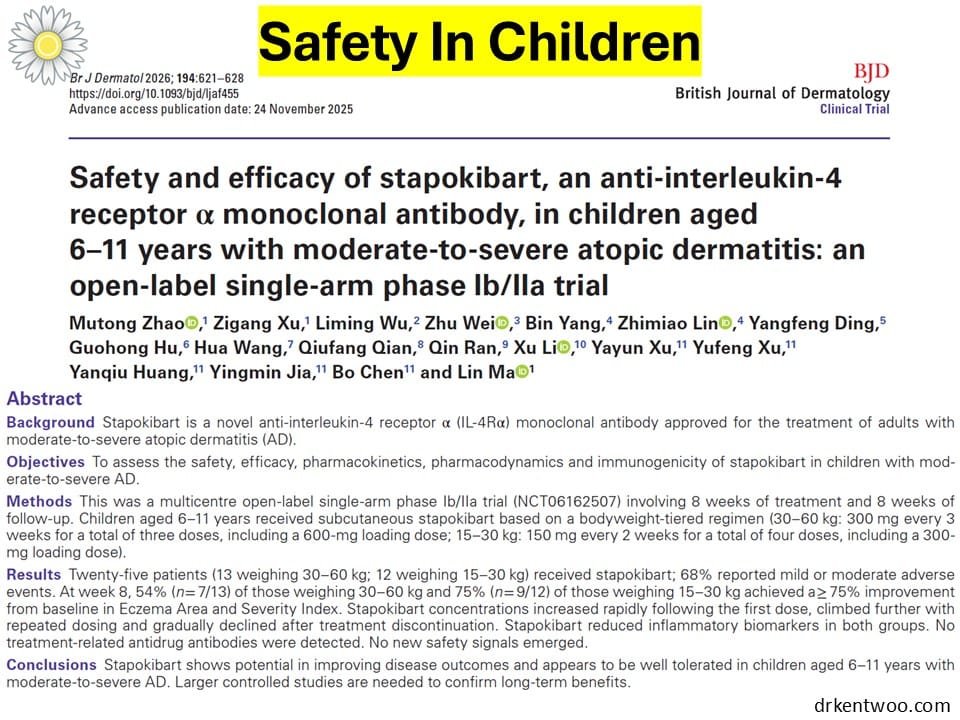
So far, stapokibart has shown a favourable safety profile in clinical studies. Longer-term data are also encouraging.
Stapokibart is newer.
That doesn’t make it unsafe.
It simply means we are still learning more about it with time.
So far, stapokibart has shown a favourable safety profile in clinical studies. Longer-term data are also encouraging.
Studies are now extending into younger age groups.
A recent study in children aged 6–11 found encouraging improvements in eczema severity and no new safety signals.
The Bottom Line

I don’t see Stapokibart as replacing Dupixent.
I see it as another option.
Dupixent remains the OG.
Stapokibart is the new kid on the block.
And for a patient whose eczema is severe, whose current treatments are not enough
Or whose current biologic works beautifully but has become financially difficult
Having another option can make a meaningful difference.
Sometimes, medicine doesn’t need a replacement.
It just needs another good choice.